The Ballot They'll Never See: Living a Double Life at the Voting Booth
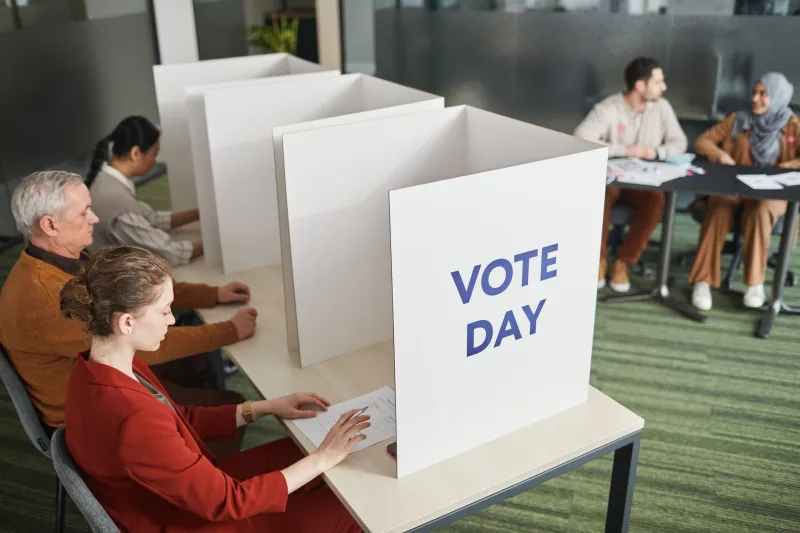
She has voted in every presidential election since 1992. Her husband has too. They have been married for thirty-one years, raised three children in a suburb of Columbus, Ohio, and share nearly everything — finances, faith, a deep attachment to the same stretch of Lake Erie shoreline where they vacation every August.
They have never once discussed who they voted for.
"We made an agreement early on," she says, speaking on the condition of anonymity. "It was the only way. We are just too different, and we both knew it."
This arrangement, which might sound unusual in the abstract, is in practice one of the most common quiet negotiations in American domestic life.
A Nation of Political Secrets
The hidden political lives of Americans represent one of the least examined dimensions of the country's polarization crisis. While journalists and researchers have devoted enormous attention to partisan sorting, geographic clustering, and the radicalization of political identities, far less scrutiny has been applied to the millions of people who have responded to political pressure not by becoming more extreme, but by going underground.
A 2023 survey conducted by the Cato Institute found that sixty-two percent of Americans reported self-censoring their political views — meaning they held political opinions they felt they could not safely express. The figure was highest among conservatives in politically liberal professional environments and among moderates of all backgrounds who felt claimed by neither side. But the behavior crossed every demographic line. Young people, older Americans, rural residents, city dwellers — the impulse to conceal was essentially universal, even if the specific fears driving it varied.
These are not people who have disengaged from politics. Many are deeply engaged. They vote, donate, follow the news with genuine attention, and hold considered views. They have simply concluded, through accumulated experience, that expressing those views to the people closest to them is not worth the cost.
The Geography of Silence
Where you live shapes the particular contours of political concealment in ways that are worth examining carefully.
In deep-red rural communities, the person most likely to be hiding their politics is often someone with progressive sympathies — a young teacher who supports expanded healthcare access, a farmer who privately accepts the scientific consensus on climate change, a churchgoer who has come to support marriage equality but cannot imagine saying so aloud in the fellowship hall.
In urban and suburban professional environments that lean heavily Democratic, the concealment tends to run in the opposite direction. A marketing executive in Seattle who voted for a Republican congressional candidate. A professor in Boston who believes certain progressive policy positions have gone further than the evidence warrants. A social worker in Chicago who quietly opposes a ballot initiative her entire professional network has championed.
In both cases, the mechanism is identical: the social cost of disclosure is calculated to exceed the benefit, and the mask goes on.
"I live in a neighborhood where there are yard signs for candidates up and down every block," says a small business owner in suburban Philadelphia who describes himself as politically unclassifiable. "If I put up a sign for either party, I would lose customers. If I said what I actually think, I would lose friends. So I say nothing."
What the Silence Does to Us
Psychologists who study political identity and interpersonal communication have documented a consistent pattern: the sustained concealment of core beliefs from close relationships carries measurable psychological costs.
The experience of presenting a false or incomplete self to people we love activates the same cognitive and emotional systems associated with other forms of deception. Over time, it can erode the sense of intimacy and genuine connection that makes close relationships sustaining. It can also produce a particular form of political alienation — the feeling of being a citizen without a community, someone whose actual views have no home in the existing social landscape.
"There is a loneliness to it that people don't talk about," says one woman who spent a decade concealing her shift away from the evangelical political commitments of her family before eventually disclosing them — and absorbing the consequences. "You feel like you are watching the conversation from outside a window. You can see everyone but no one can see you."
The costs are not only personal. A democracy depends, at some fundamental level, on the capacity of citizens to engage honestly with one another about their actual preferences and values. When that honesty is systematically suppressed — not by state censorship, but by social pressure — the quality of democratic deliberation degrades in ways that are difficult to measure but impossible to ignore.
Elected officials, after all, are responding to the political signals they receive. When those signals are systematically distorted by the gap between what people say and what they actually believe, the result is a politics that serves the performance of opinion rather than its substance.
The Particular Weight of Family
Of all the relationships in which political concealment operates, none carries more emotional complexity than the family.
The holiday dinner table has become a kind of cultural shorthand for political conflict in America — a space where ideological differences, once politely suppressed, now occasionally erupt into genuine rupture. What receives less attention is the vast majority of families who manage this tension not through confrontation but through silence: the deliberate, effortful management of what is and is not said.
For some, this silence is a form of love — a recognition that the relationship matters more than the argument. For others, it produces a slow accumulation of inauthenticity that corrodes the relationship from within. The difference often lies in whether the silence is mutual and acknowledged, or unilateral and invisible.
The couple in Columbus, Ohio, made their agreement explicit. Many Americans have not. They are simply performing, year after year, a version of themselves that their families can accept — and quietly voting for something else entirely.
Unmasking, Carefully
Behind the Mask does not suggest that full political disclosure is always the right choice, or that every family dinner requires a reckoning. Context matters. Safety matters. Relationships are complicated, and the decision to reveal a hidden political self is not one that can or should be made uniformly.
But we do believe that the scale of political concealment in this country — the sheer number of people living double lives at the ballot box — tells us something important about the state of American life that demands honest examination.
We are, collectively, more politically alone than we appear. The mask of social conformity that millions of Americans wear every day is not simply a personal coping strategy. It is a symptom of a political culture that has made honesty too expensive for ordinary people to afford.
Uncovering that truth is not comfortable. But it is, we believe, necessary.