When the Curtain Falls at Home: The Day Your Child Sees the Real You
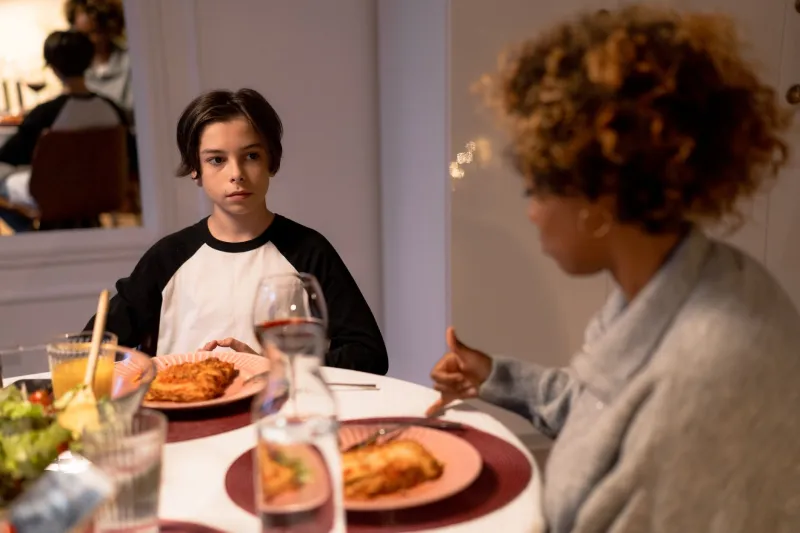
There is a particular kind of silence that settles over a dinner table when a child asks the question no parent has prepared for. Not the logistical questions—not where do babies come from or why is the sky blue—but the quiet, devastating kind: Mom, do you actually believe what you said to Grandma, or were you just saying that?
It is a question that arrives without warning. And for many parents, it is the moment the mask slips.
The Architecture of the Parental Persona
Long before their children are old enough to scrutinize them, most parents have already constructed elaborate, socially functional versions of themselves. These are not born from malice. They emerge from necessity—from the pressure to hold employment, to maintain standing in a religious congregation, to survive Sunday dinners with in-laws whose political convictions run opposite to their own, or simply to keep the peace in communities where difference is not comfortably tolerated.
A parent might attend a conservative evangelical church each week while privately holding progressive views on LGBTQ+ rights. Another might perform patriotic enthusiasm at a company barbecue while quietly voting against the interests that event implicitly celebrates. A third might nod along as extended family rehearses familiar grievances about immigration, never once voicing the dissent burning in their chest.
These performances are, in a very real sense, survival strategies. But they come with an audience no parent fully anticipates: their own children.
Children as Witnesses
Research in developmental psychology has long established that children begin reading social nuance far earlier than adults assume. By middle childhood—roughly ages eight through twelve—most children are already adept at detecting inconsistency. They notice when a parent's tone shifts on the phone with a boss. They register the careful editing that happens before a family gathering. They observe, with the uncanny precision of those who have nothing else to do but watch, the difference between the parent who exists at home and the parent who performs in public.
What they do with that observation varies. Some file it away silently, absorbing the lesson that public and private selves are simply different things—that adulthood means learning to manage both. Others grow quietly resentful, sensing that something dishonest is occurring without yet having the language to name it. And some, eventually, ask.
The asking, when it comes, is rarely aggressive. More often it arrives with the fragile directness of someone who genuinely wants to understand. Why did you say that if you don't mean it? Why do we act different around certain people? Who are we really?
These are not small questions. They are, in fact, among the most foundational questions any human being can pose.
The Conversation No Parenting Book Prepared You For
Parents who find themselves in this moment face a genuinely complex set of competing obligations. On one side sits the value of honesty—the widely held belief that children deserve truth, that modeling authenticity is one of the most durable gifts a parent can offer. On the other sits the reality that full transparency about the social masks one wears is not always safe, simple, or appropriate to share with a child.
A parent who has spent years concealing progressive politics from a deeply conservative extended family cannot simply unpack twenty years of social performance at the kitchen table without consequence. The revelation touches not just the parent's identity but the child's entire understanding of their family structure, their community, and their own place within it.
And yet the alternative—deflection, dismissal, or doubling down on the performance—carries its own cost. Children who are told, implicitly or explicitly, that the mask is the truth learn something corrosive: that authenticity is a luxury, that honesty is dangerous, and that the self is something to be hidden rather than inhabited.
What Honesty Actually Looks Like Here
The most thoughtful parents navigating this rupture tend to resist the binary. Full disclosure and complete concealment are not the only options. What many child development specialists and family therapists suggest instead is age-appropriate honesty about why people wear masks, rather than necessarily exposing every dimension of what lies beneath.
This sounds, in practice, something like: Sometimes adults say things that keep the peace, even when they don't fully agree. It's complicated, and I want to talk to you about why. It is an acknowledgment of the mask's existence without requiring a complete unveiling of everything it has been hiding.
This kind of conversation does several things simultaneously. It validates the child's perception—which is, critically, accurate. It models the capacity for nuance rather than the false choice between total performance and total exposure. And it opens a door through which, over time, more honest dialogue can pass.
What it does not do is pretend the mask was never there. That particular pretense, once a child has already seen through it, is perhaps the most damaging response of all.
The Gift Hidden Inside the Rupture
There is something worth naming in the discomfort of this moment that tends to get lost in the anxiety surrounding it: the fact that a child has seen their parent clearly enough to ask this question at all is a form of intimacy. It means the child is paying attention. It means the relationship is close enough that the gap between performance and reality has become visible.
Parents who find the courage to meet that clarity honestly—even partially, even imperfectly—often describe it as one of the more unexpectedly connecting experiences of their parenting lives. Not because the conversation is easy, but because it is real. Because it is, perhaps for the first time in that particular context, a conversation between two people rather than between a person and a performance.
The mask, after all, does not just obscure the parent from the world. It obscures the parent from their child. And children, more than almost anything else, want access to the actual person raising them.
Raising People, Not Performances
The broader cultural pressure to perform—to optimize one's identity for different audiences, to code-switch across social contexts, to present the version of oneself most likely to be accepted—does not vanish when one becomes a parent. If anything, it intensifies. The stakes feel higher. The audiences multiply. The consequences of exposure seem more severe.
But children who grow up watching their parents perform without ever witnessing the cost of that performance, or the courage it sometimes takes to step outside of it, are being prepared for a particular kind of life: one in which the mask is simply assumed to be permanent, in which the self is always managed and never fully inhabited.
That is not the only story available to them.
The moment a child asks who you really are is not a crisis. It is an invitation. What you do with it—how honestly, how thoughtfully, how courageously you respond—may shape not just their understanding of you, but their understanding of what it means to be a person in the world.
Behind every mask is someone worth knowing. The question is whether you are willing to let your child be among the ones who do.