Raising Little Actors: The Quiet Harm in Teaching Children to Mask Their Beliefs
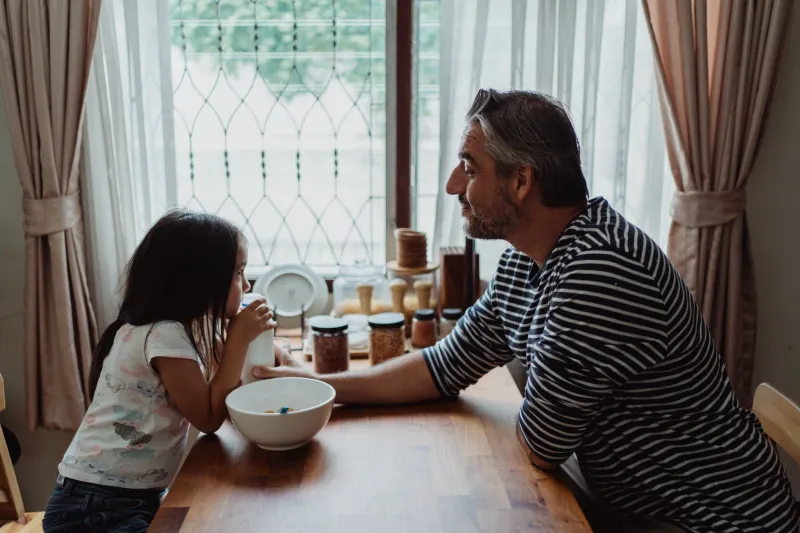
There is a particular kind of silence that settles over a child when they learn, for the first time, that what they believe is not safe to say out loud.
It is not the silence of contemplation. It is the silence of calculation.
Millions of American parents know this moment intimately — not because they witnessed it in their children, but because they engineered it. With the best of intentions, and often with a genuine fear of what honesty might cost, they pulled their sons and daughters aside and offered a version of the same quiet instruction: Not here. Not with these people. Not like that.
This is the story of the performative child — and the parents who, however lovingly, authored that performance.
The Rehearsal Begins at Home
Ask almost any parent in a politically divided household, or one embedded in a community that doesn't share its values, and you will hear some variation of the same confession. A progressive mother in rural Tennessee describes coaching her twelve-year-old before Thanksgiving dinner: "I told her not to bring up climate change with her grandfather. I said, 'He's not going to change, and it'll just ruin the meal.'" A conservative father in suburban Portland admits he warned his teenage son not to mention his views on immigration at school. "I told him the teachers would make his life difficult. I wasn't wrong."
The specific content of the lesson varies by geography, by family structure, by political tribe. What remains constant is the underlying message: your authentic self is a liability in certain rooms.
This is not a new phenomenon. Parents have long prepared children for a world that does not always welcome difference. But something has shifted in the texture of these conversations. In an era of intensified political sorting — where neighborhoods, schools, churches, and social media feeds have become increasingly homogeneous — the rooms in which a child's true beliefs are unwelcome have multiplied. The rehearsal has become more elaborate. The mask has become better fitted.
What the Research Is Starting to Tell Us
Developmental psychologists have long understood that identity formation in adolescence is a fragile, iterative process. Children learn who they are partly by testing their beliefs against the world — by expressing a value, observing the reaction, and integrating that feedback into their emerging sense of self. When that testing ground is consistently manipulated by adults who pre-screen which beliefs are permissible to voice, the developmental feedback loop is distorted.
Clinicians who work with adolescents describe a pattern they are seeing with increasing frequency: young people who are highly adept at reading a room and adjusting their self-presentation accordingly, but who struggle to articulate what they actually believe when no audience is present. They have been so thoroughly trained in the performance that the performer and the person have become difficult to distinguish — even for the child themselves.
This is not mere social fluency. Social fluency is a healthy and necessary skill. What these clinicians are describing is something closer to identity fragmentation: a chronic disconnection between inner conviction and outward expression that, left unaddressed, can calcify into adulthood as a fundamental distrust of one's own voice.
The Liberal Household, the Conservative Neighborhood
The dynamics of intergenerational masking are not the exclusive property of any single political persuasion, but they do take on distinct flavors depending on context.
In households where progressive values are held privately but the surrounding community leans conservative, children are often taught to soften or conceal views on race, gender, sexuality, and the environment. They learn to let certain comments pass unchallenged at the lunch table, to omit certain family practices from casual conversation, to navigate the social geography of their school with a kind of practiced invisibility.
In households where conservative or traditional values are held privately but the institutional environment — a school, a university town, a blue-collar neighborhood that has gentrified — has shifted leftward, children learn a mirror-image discretion. They learn not to repeat certain things their parents said at the dinner table. They learn which of their beliefs will draw social punishment and which will earn approval.
In both cases, the child receives the same foundational lesson: authenticity is a privilege, not a right, and it is one that must be rationed carefully.
The Cost We Are Not Counting
The immediate logic of parental coaching is understandable. No parent wants their child to be socially isolated, academically penalized, or emotionally targeted because of something they said. The protective instinct is real, and in many cases, the threat it responds to is real as well.
But the long-term accounting is rarely done.
When children are taught to perform rather than inhabit their beliefs, they do not simply learn discretion — they learn that their inner life is shameful or dangerous. They internalize the idea that the self must be managed, curated, and strategically deployed. They grow into adults who are extraordinarily skilled at reading political weather but profoundly uncertain about what they themselves believe when the weather is calm.
They become, in other words, people who are very good at wearing masks — and less and less sure of what face lies beneath.
This is not a metaphor. It is a psychological inheritance, passed from one generation to the next with the best of intentions and the most corrosive of effects.
Toward a Different Conversation
None of this is to suggest that parents should send their children into hostile environments without preparation or context. The world is not a seminar room, and political courage has real social consequences, particularly for young people who lack the autonomy to exit difficult situations.
But there is a meaningful difference between preparing a child to navigate conflict with grace and preparing a child to erase themselves preemptively. The first teaches resilience. The second teaches disappearance.
The more honest conversation — and the harder one — begins with parents examining their own relationship to authenticity. How much of what we ask our children to conceal are we ourselves concealing? How many of the masks we fit onto their faces are ones we have been wearing so long we no longer notice the weight?
Behind the Mask exists, in part, because we believe that transparency is not naïveté. It is a discipline — one that requires practice, tolerance for discomfort, and a willingness to be seen as we actually are, not as the room requires us to be.
Our children are watching us practice that discipline, or watching us abandon it. The lesson they take from that observation will outlast any single Thanksgiving dinner, any one carpool warning, any carefully managed school presentation.
The question worth sitting with is not whether our children are safe. The question is whether, in making them safe, we are making them whole.